Any routed KiCad board, no setup
Open a .kicad_pcb from KiCad 6 to 10 and press Energize. circsim rebuilds the circuit from the copper and matches parts to its bundled models, so there are no Sim.* fields to assign first.
Open any routed KiCad board, power it up, and probe it in 3D. An interactive SPICE bench and a read-only layout audit that catch mistakes before you pay for fabrication.
A routed board is the thing you are about to pay to have made. It might be your own KiCad layout, a contractor's delivery, or the output of an autorouter such as Quilter. Before you order it, you want to know two things: does the circuit work, and will the layout hold up?
Schematic simulators such as LTspice and KiCad's own ngspice integration run on the drawing, and each symbol needs a model assigned before you press go. circsim runs on the board file. It reads the net connectivity out of the .kicad_pcb, matches each part to a SPICE model, and gives you a bench to poke at it: apply power, read every net's voltage on the copper, drag a scope probe onto an output, and dial a knob while the waveform moves. When something is wrong, like a rail (a power-supply net) sagging to 0.3 V or an op-amp stuck at the rail, you see it on the physical board you're about to fabricate.
The second question belongs to the read-only Board Critic, which reads the layout for floating nets, clearance, decoupling distance, IR-drop, and ampacity. Know one limit up front: the simulation treats every net as a single ideal node, so copper resistance shows up in the Critic's estimates and not in the simulated voltages. A schematic is optional. If the .kicad_sch sits next to the board with the same name, circsim attaches it and uses its Sim.* fields and pin names.
SPICE is the decades-old, industry-standard way to simulate an electronic circuit by solving its equations numerically. circsim runs ngspice, a well-established open-source SPICE engine (the same one inside KiCad), fully bundled. There's nothing to install.
It is fully offline, it is MIT-licensed, and it never modifies your design files.
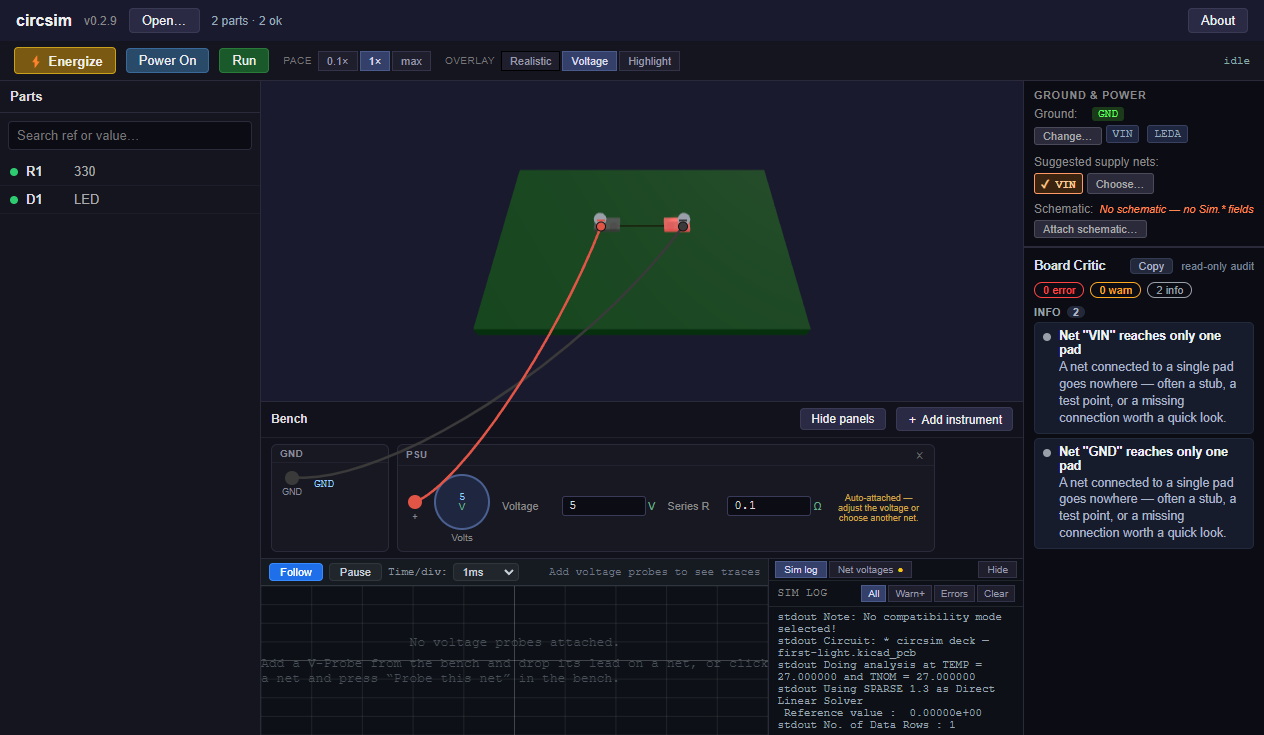
New here? Start with installing circsim, then do the First Light tutorial: a one-LED dimmer that takes five minutes and shows the whole flow end to end.